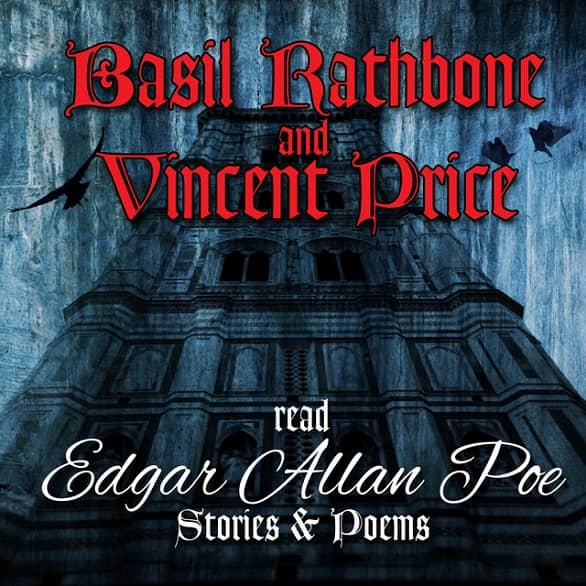
Basil Rathbone and Vincent Price - Read Edgar Allan Poe Stories & Poems (2013)
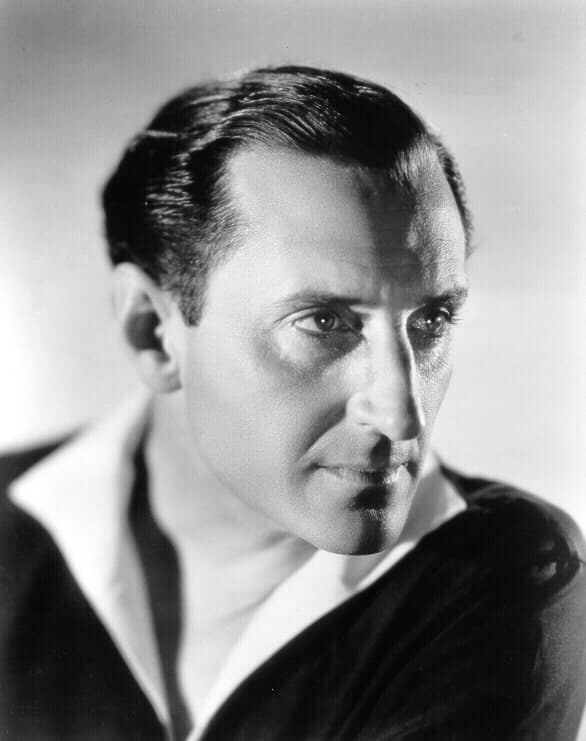
Basil Rathbone
If I say the name Basil Rathbone, I have a very good chance of guessing exactly what you'll think (if yous're sometime plenty, that is — if y'all're below a sure age, you may just remember, "Who?"); ten will become you xx you'll remember "Sherlock Holmes," the character that Rathbone indelibly portrayed in xiv films from 1939 to 1946, so successfully that for many people his name has become synonymous with the character.
And if past some adventure you don't remember of Holmes, you'll almost certainly think of the greatest swordsman in Hollywood, the piercing-eyed, hawk-visaged athlete who figured in some of the screen's nearly thrilling duels, almost famously against John Barrymore and Leslie Howard in Romeo and Juliet (1936), Errol Flynn in Captain Blood (1935) and The Adventures of Robin Hood (1938), and Tyrone Ability in The Mark of Zorro (1940), the latter boxing the most heady swordfight in picture history, in my opinion.
In improver to these swashbuckling villains, in his almost fifty twelvemonth film career Rathbone applied his singular talents to bringing many other characters to vivid life. Some of his about memorable non-activity roles are his icily sadistic Mr. Murdstone in David Copperfield, his brutally indifferent Marquis St. Evrémonde in A Tale of Two Cities, his rigid, fatally conventional Alexi Karenin in Anna Karenina (all in 1935 — studio era Hollywood worked its players difficult), and his witty, cynical Richard Three in Belfry of London (1939), with Vincent Price equally his brother Clarence and Boris Karloff every bit his murderous, club-footed henchman, Mord; truly, they don't brand 'em like that anymore!
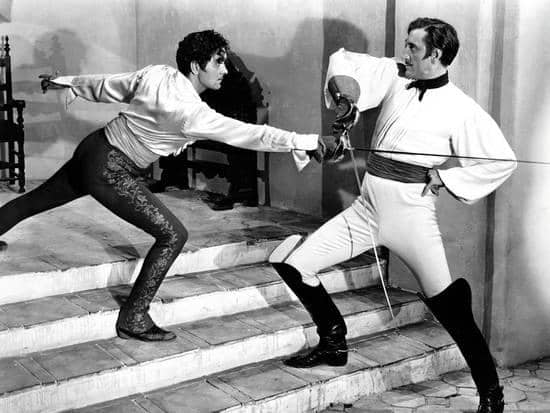
Rathbone and Ability in The Mark of Zorro
In his prime years, Rathbone was a striking physical presence; tall and virile, with deep-gear up, icy blue eyes and an aquiline contour, his sharp good looks had more than a hint of cruelty about them, and when you lot combine his arresting appearance with a brisk, dominating style that suggested a tightly coiled steel jump, he was more than than able to hold his own in whatever scene, fifty-fifty when sharing the screen with the biggest stars in the concern.
But distinctive as his looks were, Rathbone'southward greatest nugget may have been his vox. It was the perfect compliment to his appearance; hard still flexible, razor-edged and rapid in delivery equally his sword thrusts, the actor'south voice was an ideal instrument for that form of deadly combat known as polite conversation, especially every bit it was waged in the studio-manufactured castle keeps and drawing rooms of Warner Brothers and Twentieth Century Fox.
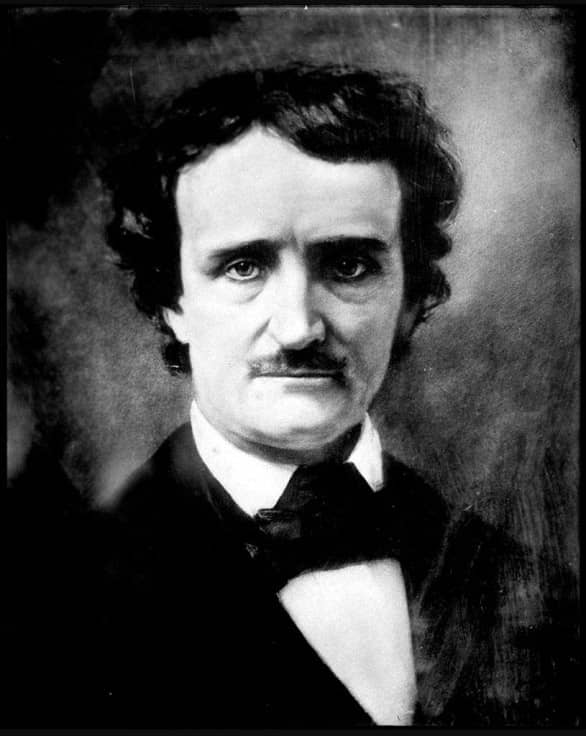
Edgar Allan Poe
Only all things must terminate, and as the thirties, forties, and fifties all slipped into the past, the Gold Age of Hollywood went with them and roles for a man of Rathbone's talents grew fewer and fewer. In whatever case, by the end of that catamenia Rathbone (who was built-in in 1892) probable wouldn't have had quite enough energy to go rushing upwards and down stone staircases swinging a sword over his caput fifty-fifty if the opportunity had offered itself — though he was nonetheless able to manage a nice comic swordfight with Danny Kaye in 1955's The Court Jester.
This meant that by the end of the fifties, Rathbone, now approaching seventy, was relegated mostly to work in increasingly inferior movies and guest appearances on television shows. Only fifty-fifty though the swashbucklers and costume movies that made him an icon had faded into Hollywood history, Rathbone's distinctive voice remained almost undiminished, and he used it to produce his terminal distinguished work, a serial of three record albums on which he read some of the greatest poems and stories of Edgar Allan Poe.
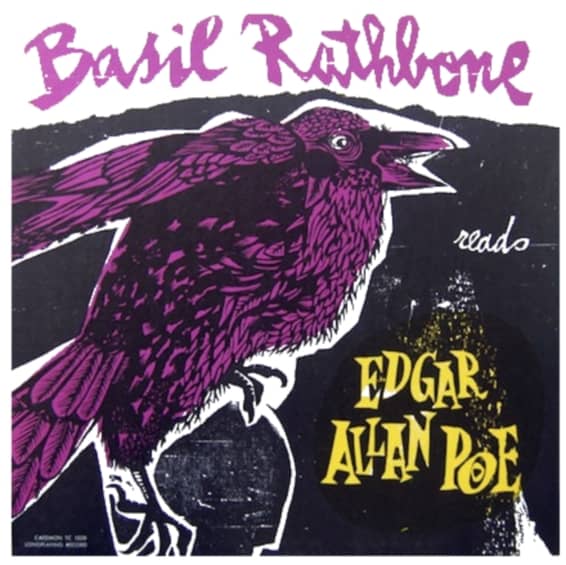
Basil Rathbone Reads Edgar Allan Poe, Volume One
The albums — all titled Basil Rathbone Reads Edgar Allan Poe — were produced past Caedmon Records, a pioneer in the field of spoken give-and-take recordings. In the get-go volume, which appeared in 1957, Rathbone reads "The Raven," "Annabel Lee," "Eldorado," "To…," "The Masque of the Ruby-red Death," "Alone," "The City in the Ocean," and "The Black Cat."
In 1960 there was a second book which included "The Cask of Amontillado," "The Facts in the Case of M. Valdemar," and "The Pit and the Pendulum."
The 3rd and concluding volume came out in 1965 and contains renderings of "The Telltale Heart," "The Bells," "The Fall of the House of Usher," and "The Haunted Palace."
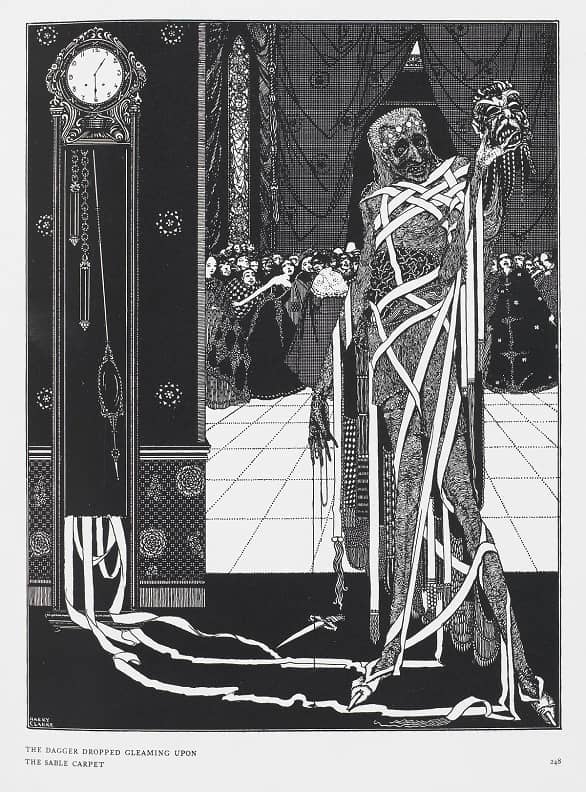
The Masque of the Cerise Death by Harry Clarke
Basil Rathbone was an ideal interpreter for this material; he was made to give voice to Poe'southward histrionic, solipsistic narrators. There isn't a weak endeavour on any of the 3 recordings, but on the first disc, he does especially well with the chill ironies of "The Masque of the Crimson Death." Rathbone sounds as if he is the eternal vocalism of Time itself, looking contemptuously down at the ridiculous blindness and self-regard of human beings and sardonically rendering its verdict on the hedonistic follies of the self-deceiving Prince Prospero and his doomed guests. Rathbone's rendition of the story'due south terminal lines,
And the life of ebony clock went out with that of the last of the gay. And the flames of the tripods expired. And Darkness and Disuse and the Cherry-red Death held illimitable dominion over all
falls on the ear like the grim, irrevocable sentence of a hanging judge or like the final despairing beats of an expiring center. Similar the rest of his reading, it is simply superb.
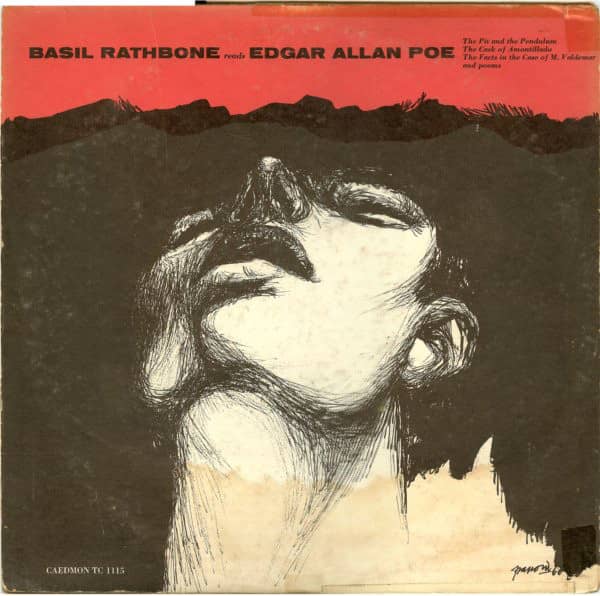
Book Two
The highlight of the 2d record is "The Cask of Amontillado," which unlike either of the tales in the first volume, allows Rathbone to display his skill with dialogue in the exchanges between the murderous Montressor and his victim Fortunato. He perfectly conveys the cunning that allows Montressor to conceal his obsessive hatred beneath a veneer of ironic politeness, and his vain, peevish Fortunato is a delight. You can practically see the fool squinting and stumbling through the shadowy vaults of the Montressors as his muddled mind gropes its mode through an alcoholic fog, a fog the gull will sally from just when he finds himself chained in his tomb. When the suddenly sobered Fortunato realizes that he has been lured into his own grave, the screams that emerge from his throat are shocking and truly terrifying.
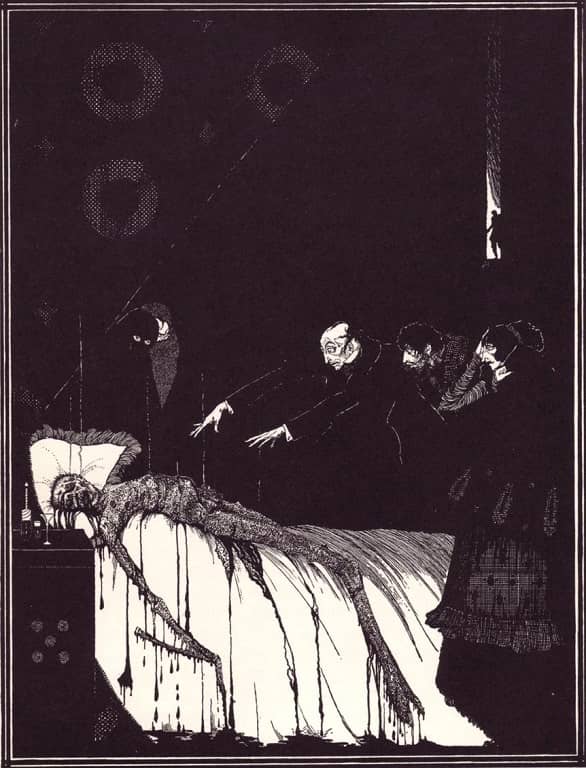
1000. Valdemar by Harry Clarke
Just as good is "The Facts in the Example of M. Valdemar." When yous hear Rathbone's rendition of the voice of Valdemar, held by hypnosis in a horrible state between life and death, your blood temperature will drop by at least twenty degrees. Poe describes it as
a voice — such equally it would be madness in me to attempt describing… the audio was harsh, and broken, and hollow; merely the hideous whole is indescribable, for the simple reason that no similar sounds have ever jarred upon the ear of humanity.
Amazingly, Rathbone does not disappoint, fifty-fifty later such a build-upwards; he manages to perfectly, chillingly convey the "vast distance" and the "gelatinous or glutinous" quality that Poe attributes to the unearthly sound that issues from Valdemar's pharynx. When the narrator asks Valdemar if he is yet sleeping and he replies in a hideous tone that is half rasping croak, half agonized whisper, "Yep; — no; — I take been sleeping — and now — now — I am dead," if your flesh doesn't experience as it's going to crawl off your bones and go hide under the bed, then you'll know that you're the 1 who'due south passed away.
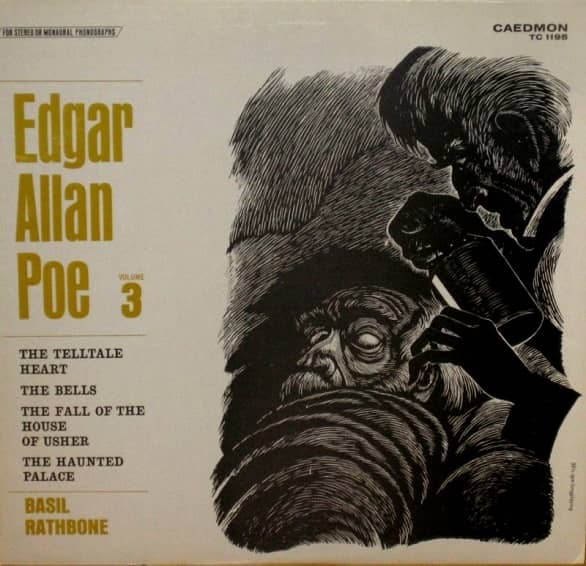
Volume Three
On the final album, Rathbone's masterful reading of "The Tell-Tale Eye" particularly stands out. As soon every bit he speaks the first line, "Truthful! — nervous — very, very dreadfully nervous I had been and am; but why will yous say that I am mad?" in a clipped, rapid voice that tin can scarcely suppress a quaver, you know that this chap has left ordinary, mere garden variety insanity far behind. His fussy pride in his preparations for his criminal offence, the bloody murder itself, and the mounting frenzy that ends in his uncoerced confession are all conveyed with the virtuosity befitting a great actor.
In all of these poems and stories, Rathbone isn't afraid of the emotional high notes (highs that often soar into outright hysteria), and he hits them unerringly. He knows that Poe isn't writing existent estate prospectuses or greeting cards; he's giving united states his own unique literary alloy of Grand Guignol and 1000 opera.
Rathbone, Toll, and Poe
The best news is that, old equally they are, all three albums can be had from Amazon, combined with Vincent Price'due south readings of several more than Poe stories ("The Imp of the Perverse," "Morella," "Ligeia," "Berenice," and "The Gold Bug," all of which Price had done on Cademon albums of his own) under the title Basil Rathbone and Vincent Price Read Edgar Allan Poe Stories & Poems. (If the championship alone doesn't get your pulse racing, come sit over here — nosotros demand to have a talk. I'll simply manacle you to the wall and so we won't be disturbed. You lot can sit on that pile of bricks…what are they for? Don't worry nigh it.) If you lot have Amazon Prime you can stream the whole matter for free; it's too bachelor as an MP3 album for less than ten dollars — the bargain of the century, I'd say. Or, if you adopt, every track from all three Rathbone albums can be heard on YouTube.
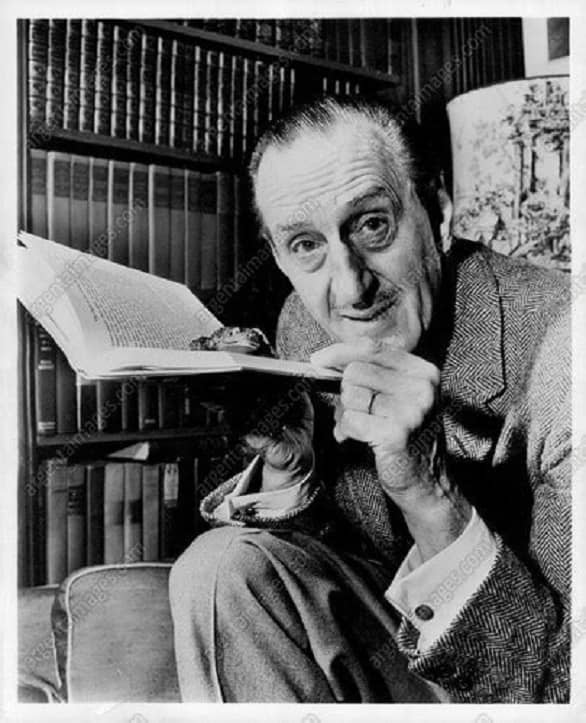
The Storyteller
Nonetheless you lot cull to listen to these magnificent interpretations of Poe's tormented masterpieces, do it. Lock the doors, put away the phone, decline the lights, and just listen. Leave the already dying present moment backside and surrender yourself to the timeless, to what those who came earlier us knew was the greatest, nearly powerful entertainment medium ever devised — the voice of a master storyteller, coming to you out of the nighttime.
Thomas Parker is a native Southern Californian and a lifelong science fiction, fantasy, and mystery fan. When not corrupting the adjacent generation as a fourth grade teacher, he collects Roger Corman movies, Silverish Age comic books, Ace doubles, and despairing looks from his married woman. His last article for the states asked Will the Existent Captain Marvel Please Stand up Up, or Why Can't the Earth's Mightiest Mortal Use His Own Name?
Source: https://www.blackgate.com/2019/05/06/the-storytellers-voice-basil-rathbone-reads-edgar-allan-poe/
0 Response to "Basil Rathbone and Vincent Price - Read Edgar Allan Poe Stories & Poems (2013)"
Post a Comment